|
Journey the Band
Shortly after we moved to Sedona we discovered the Sedona International Film Festival, now in its 32nd year. I'm neither a film buff nor was I a big fan of the band Journey. I do love rock & roll though, and a film about the band Journey and the pluckage of Arnel Pineda to be their front man was on the Festival program. Loved the film far more than most R&R documentaries.
Journey the Jargon
I always thought I knew the difference between sales and marketing. I just looked it up with Google's AI and I was right! Well, mostly—their definition was more succinct and possibly more accurate than the hand waving one would elicit by asking me.* Recently I have been communicating with a genuine professional marketing person, and learned a new jargon: "Journey." Here's how Google defines it:
A marketing journey is the complete series of interactions a customer has with a brand, from initial awareness to becoming a loyal advocate. It involves understanding and influencing the customer's experience at each stage through personalized, automated communication and content to build a strong, lasting relationship. This strategy moves beyond broad, one-size-fits-all campaigns to deliver targeted messages based on individual customer behavior and needs.
I think this explains why you never get just one useless spam, but rather a whole series of them with a somewhat different exhortation in each successive one. It's a journey. And it's automated.
Journey the Journey
Here in Sedona I have a saying: "The men can't hear and the women can't see." To be sure, it's just my saying, and only slightly true and with many qualifications. It took me a while to decide to write this item, which is more "personal" than usual since it deals with a medical imperfection.** But here goes:
I wear hearing aids. One might think I'd be shy or even embarrassed by that, but I'm not. I've been in the audio business for my entire life, and I used to depend on my hearing to some extent for my livelihood. Now I depend on that of other people, almost all of whom are of the younger persuasion. The subtleties of higher frequencies sometimes elude me, but it's essentially no treble at all. I'm very lucky in a major respect: There's nothing wrong with my hearing except my advanced age. There's no specific pathology or defect not attributable to a childhood riding screeching New York City subways and an alleged adulthood of loud rock concerts. And, of course, genetics. But I promised a journey, and at least for now it has a happy ending.
The hearing journey began, I assume decades ago. I only became aware I was on one when my wife pointed out that I kept asking her to repeat what she had just said and that my hearing must have gone bad. In large part*** she was right and convinced me with only small effort to take a hearing test. In a moment, the results of that test. But first, the canonical explanation of hearing. Thank you National Institute! That was easy! They even have an animated video that begins with the term "Journey" so how could I resist? Normal hearing allows one to detect sounds in the nominal frequency range of 20 to 20,000 Hz. With age, both in my case and in general, the higher frequencies above 1000 Hz become progressively less audible. Since those frequencies contain important elements of spoken language, it becomes harder to understand speech.
Hearing aids boost the attenuated frequencies, allowing some semblance of normal hearing to return. An individual's hearing test circuitously determines how much and at what frequencies the hearing aids should be adjusted to accomplish this. Simple! At least until Part Three of my Journey.
Part One: I took a hearing test. My hearing was much worse than I anticipated, but easily corrected with hearing aids. It was a quite a revelation how much I was missing. Did you know we have birds here in Sedona?
Part Two: About four years later my wife again noticed that I was having trouble understanding her. Another hearing test. Time for newer hearing aids, which had technologically improved in the interim. Did the birds get louder? I think so but I'm not sure I remember.
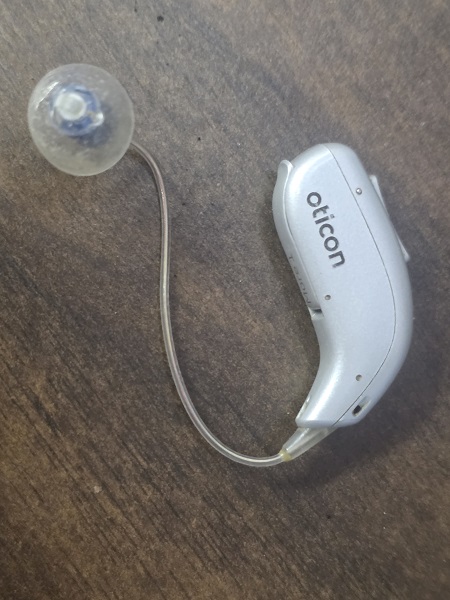
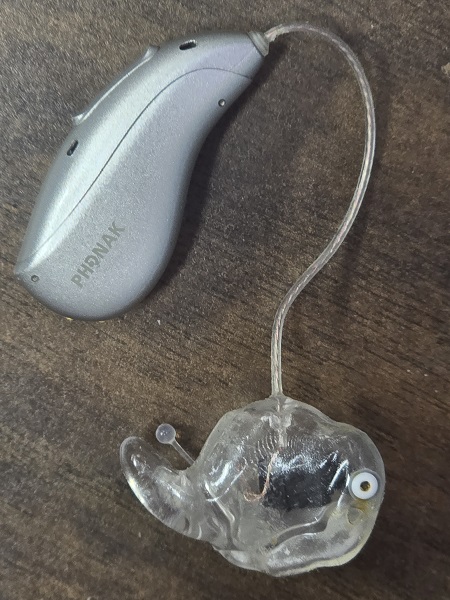
Part Three: Same spousal complaint, same candidate remedy. But this time the results of the hearing test hadn't changed significantly, and I didn't feel that there would be that much improvement. But instead of a revelation, I had an inspiration. My own main complaint about the previous hearing aids was that they weren't adequate for music listening. My improvised solution, better but not great either, was to jam a pair if Samsung earbuds or Apple AirPods over the hearing aid earpiece. Looked stupid, and they'd occasionally fall out, but were a musical improvement. I put my Hearing Professional to the Question: Can I get a pair of hearing aids that make music sound as good as do proper ear buds? YES!
 |
 |
| Oticon hearing aid (from Part Two) with generic earpiece |
New Phonak hearing aid with molded earpiece |
How's your patience holding up? Good!
In the almost-decade of my hearing Journey, even I, an audio person forever, was impressed by the advances in the adjacent field of hearing science. And by how important it is having the right Hearing Professional, for whom an unpaid advertisement follows. My wife—who started wearing hearing aids shortly after I did—and I visited Applied Hearing Solutions in Scottsdale, where Dr. Kelsey Beck plies her trade. The fact that we both attended together was very valuable***, but the part I especially enjoyed was Dr. Beck's rotating computer screen. On it were graphs of my hearing, the processing curves of the hearing aid, and most critically, an overlay of diphthongs which showed how distinguishable they would be based on my aid-corrected hearing. I had never seen anything like that, and I felt it immensely valuable in understanding the correction process and its limitations.
The Promised At Least For Now Happy Ending
The Phonak hearing aids have a few more years of technology, but the critical part of the journey was the laser scan of my ears which translated to the goofy-looking custom earpiece. I do a lot of walking, sometimes beside a busy highway. I love music. with the new hardware and app, I can turn off the hearing aid's augmentation which greatly reduces the traffic noise, and play music through the molded earpiece. It sounds great!
An Aside |
As one accumulates additional years, one experiences, knowingly or not, cognitive changes. One notices "senior moments" more frequently as time progresses. Furthermore, in a combination of my cognition and (their) culture, I have noticed that I often have difficulty understanding the speech of young people. In extreme cases I remind my interlocutor that "You are a young person and we old people listen slower than you talk." Sometimes it works for even more than one sentence. I bring this up for two reasons:
1: Kudos to Dr. Beck for speaking clearly and with an appropriate cadence and amplitude. It is an unusual pleasure to converse with someone who, by predilection, training, necessity and profession makes it an absolute priority to be clearly understood.
2: It wouldn't be the RIKLblog if I didn't emit an editorial whine about something. Please, young people, jargonize if you must, but at least do it more slowly!
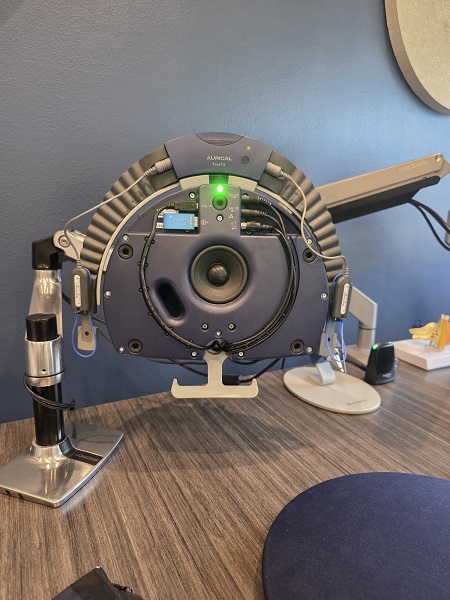
If you read the reviews of Dr. Beck, you'll see a lot about how pleasant an experience a visit is, how clean the office is, but nothing about the great hardware on her desk! The Aurical Hearing Aid Fitting System, a marvel of mechanical design, has a little microphone that goes into your ear ahead of the hearing aid earpiece and determines how well the hearing aid is transmitting sound to you! Clever and even cute, not to mention vaguely menacing when its decorative cover is removed. (There's also software—the Otosuite—associated with it. But hardware photographs better.) |
 |
Journey the Credit
Aperiodically "the bank" sends me a message entitled "Credit Journey®" complete with the marca registrada. The headline of the message I just received was "It looks like your score went down." <Fiction>I immediately panicked and looked at my score, which indeed went down.</Fiction>. In truth, I ignored the message because my score, like yours, varies between 300 and 850, and typically hovers within a band of 50 or so which has no significance to me or to anyone else. That email, along with the incessant "offers" of which I can't possibly take advantage (or remember) is part of "the bank's" campaign to get me to...
To what? Visit more often? "Recommend" it to my "friends"? Spend more time committing acts of banking? Remind me that I have a bank? I have no idea! Why do banks send so many emails? If you're a bank, please let me know.
Journey the Update - 13 August 2026
In an article in yesterday's Wall Street Journal, I discovered that
"University of Michigan Drops First-Semester Grades to ‘Curb Mental Health Crisis’"
Instead of a letter grade, first-semester transcripts will show “pass or no credit.” The program is designed to help students “acclimate to the demands of college and allow intrinsic motivations to guide personally meaningful academic journeys,”
* This sentence embodies an "em-dash" which itself embodies a hyphen. I recently read that using an em-dash is a hallmark of AI-produced text. I've been using em-dashes for decades before AI, so hopefully AI-detection software won't tar my blogitems with that brush. Hyphens are much more popular than em-dashes.
** About which, along with HIPAA, I'll have more to babble soon.
*** Also a subject about which I shall expatiate in due course. Yes, I made double use of the triple asterisk.
|
|